
Alumis (ALMS) Halves on a Lupus Miss: Why I'm Now on the Other Side of the Trade
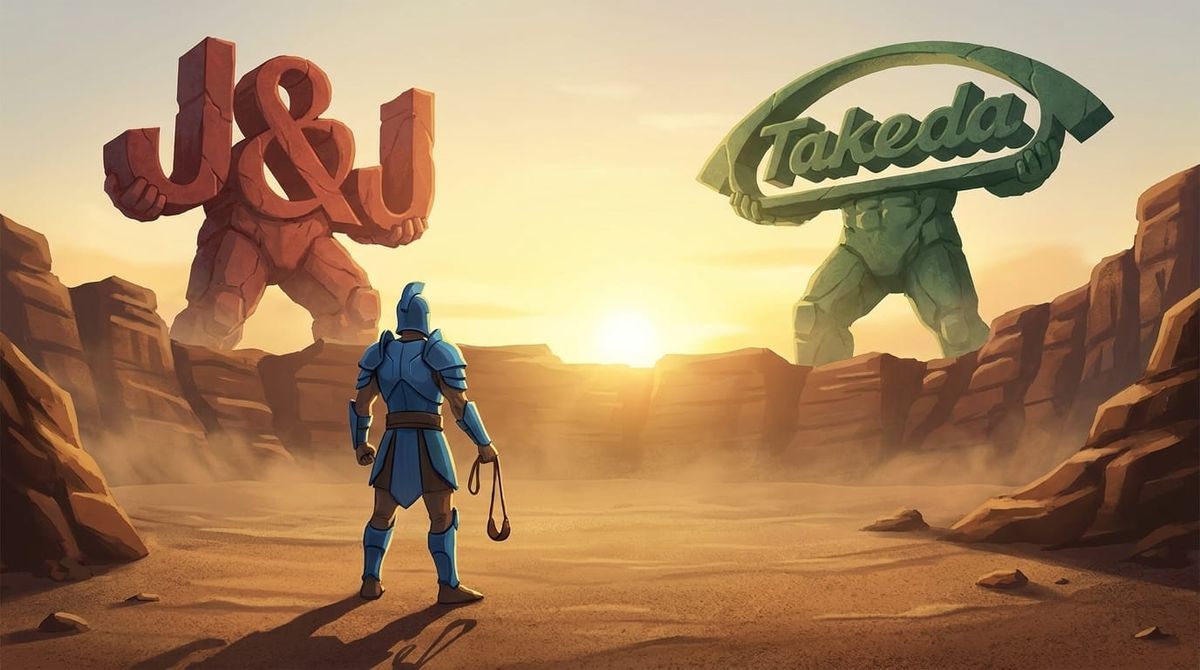
In January I shorted the ALMS overnight gap ahead of the ONWARD psoriasis readout and got slaughtered when envudeucitinib posted best-in-class PASI 100 numbers (my January piece). Eight months later the stock has round-tripped for the opposite reason. On September 1 the Phase 2b LUMUS trial in systemic lupus erythematosus (SLE) missed its primary and secondary endpoints in the overall population, and ALMS fell as much as -60%, touching $8.75.
This time I am on the long side. The market erased roughly $1.5 billion of value for a program Morgan Stanley was carrying at about $500 million risk-adjusted. What's left is a Phase 3-complete oral psoriasis drug with the highest reported PASI 100 rate among orals, an NDA due within three months, $502 million in cash, and a management team that has sold three companies for a combined ~$10 billion. At a $1.34 billion market cap and roughly $840 million enterprise value, the setup favours new buyers over sellers. But I learned in January that sloppy competitive framing gets punished, so I want to be precise about what this drug can and cannot do commercially.
Executive Snapshot
What Actually Happened in LUMUS
LUMUS randomised 408 patients with moderate-to-severe, autoantibody-positive SLE on background therapy across three doses and placebo, with BICLA response at Week 48 as the primary endpoint [NCT05966480]. It was designed and sized as a potentially pivotal trial. It did not get there.
Source: Alumis LUMUS topline presentation, Sept 1, 2026. Green = nominally significant (p<0.05); red = missed. Primary endpoint: BICLA at Week 48.
The company's explanation is the interferon gene signature, and it holds up better than most post-hoc rescues:
- SLE splits into IFNGS-high patients (typically 70-80% of moderate-to-severe cases), who respond to interferon-pathway drugs, and IFNGS-low patients, who don't and who post high placebo rates.
- LUMUS enrolled only ~60% IFNGS-high, versus ~82% in AstraZeneca's anifrolumab TULIP trials — a worse mix than any prior interferon-pathway trial.
- In IFNGS-high patients, 40 mg BID separated cleanly: 52.6% vs 28.6% BICLA (+24 points), with similar gaps on SRI-4 and CLASI-50.
- In IFNGS-low patients the drug was numerically worse than placebo on BICLA (24.4% vs 47.5%) — that drag sank the overall result.
- Important nuance: the subgroup was pre-specified and measured at baseline, not invented after the fact. What Alumis did not do was enrich enrolment for it — a defensible broad-label choice (BMS made the same one in PAISLEY), but one that left the trial exposed to the mix it got. Bad design and bad luck, in roughly equal measure.
Three things survive the noise:
- Target engagement is unambiguous — interferon gene signature counts suppressed to near-floor at 40 mg BID.
- Safety held over 48 weeks in a sick population: fewer TEAEs, SAEs and serious infections on drug than placebo; no MACE, no malignancies.
- The IFNGS-high effect sizes are competitive — in the same range as anifrolumab's pooled TULIP result (+18 BICLA) and ahead of deucravacitinib in PAISLEY.
That is a real Phase 3 hypothesis, and the company will take it to FDA and EMA End-of-Phase 2 meetings. But an enriched lupus Phase 3 is a $200-300 million, three-year project — and this company should not be the one funding it.
The Psoriasis Asset Is Intact
Nothing in lupus changes the ONWARD data. For readers who did not follow the January and March readouts, the replicate Phase 3 programme randomised 1,771 patients to envudeucitinib 40 mg BID, placebo or apremilast [NCT06586112, NCT06588738]:
Values shown as ONWARD1 / ONWARD2. All p<0.0001 vs placebo and apremilast, NRI. Source: Alumis AAD 2026 presentation.
What the table doesn't show:
- The durability number is the headline. ONWARD3 at Week 48: 54% PASI 100 and 75% PASI 90 on continuous drug (NRI) — the highest one-year clearance reported for any oral [Alumis PR, Aug 10, 2026]. Roughly 90% of Week 24 PASI 90 responders held their response.
- Safety is the clean TYK2 class profile: 2.0% SAEs, 0.7% serious infections, no MACE, no deaths, no cytopenia or TB signal across 1,280 exposed patients through Week 24. Acne (6.0%) and headache (8.4%) are the class tells.
- Next up: two-year Phase 2 safety data in 2H 2026 — not a stock-mover, but it removes the last objection to the NDA package and is exactly what a buyer's diligence team wants to see.
The Three-Horse Oral Race
Here I have to correct my January framing. I argued that icotrokinra made envudeucitinib irrelevant. The data say the three next-generation orals are close to interchangeable on efficacy, and the race will be decided on dosing, label breadth, launch timing and payer contracting.
| Icotyde J&J |
Zasocitinib Takeda |
Envudeucitinib Alumis |
|
|---|---|---|---|
| Dosing | Once daily | Once daily | Twice daily |
| US launch | Launched 2Q'26 | ~Late 2027 | ~1H 2028 |
| PASI 100, Wk 24 | 41.5% / 33.2% | 42.3% / 32.1% | 41.0% / 39.5% |
| One-year PASI 100 | n/d (adol. 57%) | Not disclosed | 54% (Wk 48) |
Cross-trial comparisons are not head-to-head; populations, endpoints and imputation differ. Efficacy shown as trial 1 / trial 2 where replicate studies exist. Approval and launch dates are the author's estimates from stated filing guidance and standard 10-month review clocks.
My read of the table, boiled down:
- The efficacy gap is inside cross-trial noise. Envudeucitinib's real edge is depth over time and speed of symptom relief (itch and DLQI improve before skin clears). Its real disadvantage is BID dosing against two once-daily competitors, in a market where the whole point of a pill is convenience.
- The QD slippage is the red flag. A once-daily formulation was supposed to be "established in 2025" [Q3'25 letter]; AAD downgraded that to "under development." It can't go into the 4Q26 NDA and needs a bridging study plus supplemental filing. A buyer will discount the asset for every month that programme stays undefined.
- The incumbents are beatable. Sotyktu ($291M in 2025) never separated enough from Otezla ($2.27B) to win the payer step-through fight. All three next-gen orals clear that bar by a wide margin — that's why J&J calls Icotyde a "must-win launch" and Takeda talks about a $3-6B peak. The oral segment expands from here.
- One caveat on the payer story: at ~$98K list, Icotyde is priced like a biologic. The savings argument lives in net price after rebates — precisely the game a single-asset biotech cannot play alone.
- Biologics are a distant third threat. Oruka's ORKA-001 (63.5% PASI 100 at Week 16 in Phase 2a, aiming for once- or twice-yearly dosing) threatens Bimzelx and Skyrizi, not the orals — a needle-avoider doesn't care whether the needle is monthly or annual. Ranked by threat to envudeucitinib: Takeda first, J&J second, biologics third.
Financial Health and the Solo-Launch Trap
The Q2 numbers: $502.3M cash, ~$95-100M quarterly underlying burn (R&D $85.3M, G&A $23.4M), runway guided "into 4Q 2027" [Q2'26 PR]. The Q2 net loss of $142.2M included a $41.8M impairment on lonigutamab, the Acelyrin antibody now up for strategic alternatives.
Walk the cash forward and the trap becomes obvious:
- LUMUS spend rolls off, but the ONWARD extensions, NDA, pre-commercial build and QD bridging work do not. Call it $80-90M a quarter.
- That puts ~$400M at the 4Q26 NDA and roughly $100-150M at a 4Q27 PDUFA date.
- A US dermatology launch costs $150-250M in year one, before a dollar of revenue.
- Conclusion: the balance sheet funds the drug to approval and no further. A solo launch means a $300-500M raise in 2027, at a depressed share price, into a market where J&J has been detailing for 18 months and Takeda is launching with a once-daily pill and a Sotyktu-superiority label.
A solo launch would be the worst decision this management team could make. No salesforce, no payer contracts, no products to bundle, and a BID pill. Envudeucitinib is worth the most inside a company that already has derm reps in every territory and a rebate relationship with every PBM. The natural buyers:
- Amgen — Otezla ($2.3B) faces generics from 2028; its oral psoriasis salesforce would otherwise have nothing to sell.
- AbbVie — Skyrizi and Rinvoq, but no oral psoriasis asset.
- Novartis, UCB, Lilly — each defending an IL-17 biologic with no oral.
- Sanofi — has bought from this management team before. Twice.
This Management Team Sells Companies
- Martin Babler (president, CEO, chairman): ran Principia Biopharma from 2011 until Sanofi bought it for $3.68B cash in October 2020, two years after a $17 IPO. Before that, built Genentech's immunology commercial organisation — he knows exactly what a derm launch costs.
- Jörn Drappa (CMO): co-founded Viela Bio, bought by Horizon for $3.05B in 2021.
- John Schroer (CFO): CFO of Translate Bio when Sanofi paid $3.2B for it the same year.
- Three executives, three exits, ~$10B of consideration, two to the same buyer.
- The September 1 deck explicitly flags "ongoing partnering discussions," and a strategic review is already running for lonigutamab.
None of that guarantees a deal, and nobody wants to sell at a 54% discount to the prior week. But the discount cuts both ways: at an $840M enterprise value, a buyer paying a 100% premium still gets a Phase 3-complete oral psoriasis asset for under $2.5B — well under the $4B Takeda paid Nimbus up front for zasocitinib in early 2023, before a single Phase 3 patient was dosed. The most probable path is a psoriasis-first partnership or acquisition inside the next 12 months, ideally before the NDA is filed so the acquirer owns the label negotiation.
What I Would Do Differently From the Company
- Psoriasis: make the QD formulation the only discretionary R&D dollar that gets spent, and disclose a timeline.
- SLE: LUMUS already delivered proof-of-concept in IFNGS-high patients. Lock the enriched Phase 3 design at the End-of-Phase 2 meetings, then let a partner fund it — don't spend two years re-learning what the subgroup already showed.
- The "pipeline in a pill": the $180B TAM slide, the CNS-penetrant A-005 programme and the 2027 new-target candidate are exactly the spending that should stop the day a psoriasis deal is signed.
Risks
- Management goes it alone: a $300-500M dilutive raise, a late launch with a BID pill, and a valuation that reflects the Sotyktu experience rather than the ONWARD data.
- The NDA draws a data request that pushes approval into 2028.
- Takeda secures a broad Sotyktu-superiority label that turns "TYK2" into a two-drug conversation Alumis is not part of.
- Regulators refuse the IFNGS-high subgroup as a Phase 3 basis without another Phase 2.
- A strategic buyer simply waits for the PDUFA date and pays less.
- Valuation framing: the 52-week low is $3.76, set before the January ONWARD readout. At $10 the stock is still 170% above that. "Oversold" is relative to what the psoriasis asset is worth, not to where the chart was last winter.
Bottom Line
I got ALMS wrong in January because I underrated the drug. The market is now making the opposite mistake, treating a lupus design failure as a referendum on a psoriasis asset whose data have only improved since. Envudeucitinib is a top-three next-generation oral — disadvantaged on dosing and timing, advantaged on depth of clearance — held inside a company that cannot afford to launch it and run by people who know how to sell one. At an $840 million enterprise value, the asymmetry favours new money, but only if the company acts like a seller and not a builder. Optionality it cannot fund is not optionality; it is dilution. Speculative Buy, sized for a strategic outcome, with the two-year safety data and any QD formulation update as the near-term checkpoints.
Position Snapshot
| Entry date | — |
|---|---|
| Avg Price | — |
| Last Close | — |
| P/L % | — |
| Market Cap | — |
Disclaimer
The information provided on this website is for informational purposes only and should not be construed as
financial, investment, legal, or professional advice. While efforts are made to ensure accuracy, no guarantee
is given regarding completeness or reliability. Visitors should conduct their own research or consult a qualified
advisor before making any decisions. External links are provided for convenience and do not imply endorsement.
Sources: Alumis LUMUS Phase 2b topline presentation (Sept 1, 2026); Alumis AAD 2026 ONWARD1/2 presentation (Mar 29, 2026); Alumis Q2 2026 results; Alumis ONWARD3 48-week press release (Aug 10, 2026); Alumis Q3 2025 results; J&J Icotyde FDA approval and ICONIC-LEAD 52-week releases (Mar 2026); Takeda LATITUDE PsO-3001/3002 (Mar 28, 2026) and LATITUDE Atlas (Jun 11, 2026) releases; Oruka EVERLAST-A Week 16 release (Apr 27, 2026); BMS Q4 2025 and Amgen Q4 2025 results; Sanofi/Principia, Horizon/Viela and Sanofi/Translate Bio transaction announcements; Schedule 13D/A (Apr 3, 2026); RTTNews, Investing.com and Endpoints News coverage.