CGTX Update: Why I Closed My Position — And What Changed
When the thesis changes, the position has to change with it.
This is a follow-up to our four-part series on Cognition Therapeutics ($CGTX). For the original analysis, see Part 1, Part 2, Part 3, and the Final Investment Thesis.
The Original Thesis
When I first covered Cognition Therapeutics from July 2025, the investment thesis was built on a specific foundation: two parallel, six-month Phase 3 trials in Alzheimer's disease, enriched for below-median p-tau217 patients, with FDA concurrence on the study design. The idea was straightforward — if the biological signal detected in SHINE's subgroup analysis was real, properly powered enriched trials should confirm it within a compressed timeline. That's the bet I sized at $0.65 per share.
That thesis no longer holds.
What Actually Happened
On March 26, 2026, Cognition reported its Q4/FY 2025 financial results and laid out a clinical development update that effectively confirmed what had been building since late 2025: the company's near-term priority has shifted from Alzheimer's disease Phase 3 initiation to DLB psychosis.
Here's the timeline of the pivot:
The company completed a Type C meeting with the FDA on January 21, 2026, to discuss a proposed Phase 2b study of zervimesine in DLB. By March 2, the company announced it was advancing zervimesine toward a registrational program specifically for DLB psychosis — not broad DLB, but psychosis symptoms (hallucinations, delusions, agitation). And in today's earnings release, CEO Lisa Ricciardi confirmed the direction: the near-term focus is a meeting with the FDA Division of Psychiatry by mid-2026 to seek alignment on a registrational path for DLB psychosis.
As for Alzheimer's? The company's language is telling. The 545-patient START trial in MCI/early AD has completed enrollment, with topline results expected in 2027. But critically, management stated that the decision on a registrational program in AD will follow those START results.
Translation: the two parallel six-month Phase 3 AD trials that the FDA concurred with back in August 2025 are not being initiated. They're effectively shelved until START reads out — a year or more from now.
Why This Changes the Thesis
Let me be specific about what mattered in my original bull case and what's different now.
The AD Phase 3 timeline was the catalyst. My thesis wasn't that zervimesine is a bad drug. The mechanism — displacing toxic oligomers from the sigma-2 receptor — remains scientifically interesting, and the SHINE subgroup data in below-median p-tau217 patients still shows a compelling signal (95% slowing on ADAS-Cog 11, consistent across mild and moderate disease). None of that has changed.
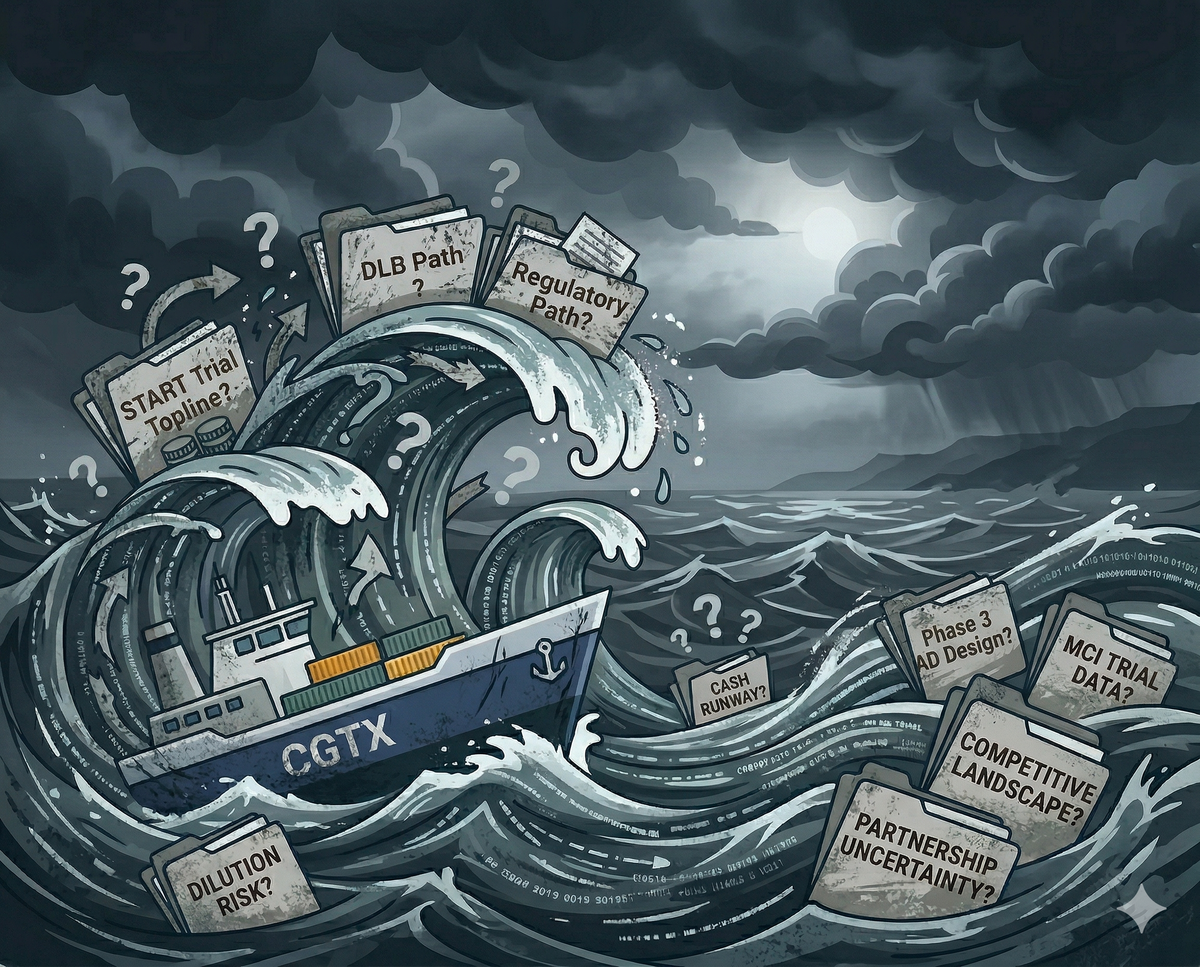
What changed is the path to value creation for shareholders. An AD Phase 3 initiation would have been a concrete, near-term catalyst with a defined regulatory pathway. Instead, the company is pursuing a DLB psychosis indication that, while medically meaningful, introduces substantial additional uncertainty:
First, the regulatory pathway is undefined. CGTX hasn't yet met with the FDA Division of Psychiatry. They're requesting a meeting for mid-2026. There is no concurrence on endpoints, trial design, or what constitutes a registrational program. Compare this to the AD program, where FDA had already explicitly agreed to the enrichment strategy, the six-month trial duration, and the dual-study design.
Second, DLB psychosis is clinically messy. DLB is the second most common form of dementia, affecting an estimated 1.4 million Americans. Up to 75% of DLB patients experience psychosis — hallucinations, delusions, and behavioral disturbances that often lead to institutionalization. The unmet need is real and significant. But DLB is notoriously difficult to diagnose accurately (definitive diagnosis still requires autopsy), patients present with highly variable symptom profiles, and cognition fluctuates dramatically — sometimes within the same day. Designing a clean, adequately powered trial around psychiatric endpoints in this population is a formidable challenge.
Third, the competitive context for DLB psychosis is worth watching. There are currently no FDA-approved treatments specifically for DLB psychosis. Traditional antipsychotics like haloperidol are often contraindicated in DLB patients because they can cause severe parkinsonism, sedation, and immobility — a phenomenon known as neuroleptic sensitivity that affects up to half of all DLB patients. That's a genuine gap. But the broader neuropsychiatry pipeline is active. Bristol Myers Squibb's xanomeline/trospium (Cobenfy), already approved for schizophrenia, is being studied in the ADEPT program for Alzheimer's psychosis, with results expected by end of 2026. MapLight Therapeutics received FDA Fast Track designation for ML-007C-MA in Alzheimer's disease psychosis. If either succeeds in dementia-related psychosis more broadly, DLB could be addressed off-label before CGTX ever reaches registration.
Fourth, the timeline stretches dramatically. Even in an optimistic scenario — FDA alignment by late 2026, trial initiation in early 2027, enrollment over 12-18 months, followed by data readout — you're looking at 2029 at the earliest for registrational DLB data. The AD program, meanwhile, won't produce a Phase 3 decision until after START reads out in 2027, meaning an AD Phase 3 wouldn't begin until 2028 at the earliest. We're now talking about a 3-4 year holding period before either program reaches a value inflection.
The Dilution Problem
This is where the financial reality bites hardest.
Cognition ended 2025 with approximately $37 million in cash plus $35.7 million in remaining NIH grant funding. The company estimates it has sufficient cash to fund operations through Q2 2027. That's roughly 15 months of runway.
But look at what happened in 2025: the weighted average share count jumped from 39.7 million to 72.8 million — an 83% increase in a single year. That $30 million raise in August 2025 came at a massive cost to existing shareholders. The company reported a net loss of $23.5 million for FY 2025 (after $23.4 million in grant income), and operating expenses were $47.8 million.
Here's the uncomfortable math: even if operating costs decline as SHINE and SHIMMER wrap up, CGTX will need to fund a new DLB registrational trial, maintain the START trial through readout, and cover G&A. The $35.7 million in NIH grants is earmarked for specific studies and can't be freely redeployed to a DLB psychosis trial. The company will almost certainly need to raise capital again before Q2 2027, and likely multiple times before any program reaches a registrational milestone.
At a market cap hovering around $98 million and a stock price of roughly $1.13, each capital raise will be meaningfully dilutive. If the company needs to raise, say, $50-60 million over the next two years to fund both programs, shareholders could see their ownership diluted by another 50%+ from current levels.
What I Did
I closed my remaining CGTX position at an 81% profit. The entry at $0.65 and the run-up through the EOP2 meeting and subsequent DLB milestones provided a solid return. But the investment thesis I originally underwrote — near-term AD Phase 3 initiation as the primary catalyst — no longer exists.
To be clear: I'm not saying CGTX is a bad company or that zervimesine doesn't work. The SHIMMER Phase 2 data in DLB showing 86% slowing on NPI-12 is genuinely interesting, especially the effects on hallucinations and delusions in a population that can't tolerate conventional antipsychotics. The EAP with 32 patients generating real-world data is a positive signal. And if the START trial in early AD delivers strong results in 2027, this story could come roaring back.
But investing in clinical-stage biotechs is about matching risk to timeline and catalyst clarity. Right now, CGTX is asking shareholders to hold through:
- An undefined DLB regulatory pathway (meeting not yet held)
- A multi-year timeline to registrational data in either indication
- Inevitable dilution to fund operations
- A pivot away from the program that had the clearest regulatory alignment
That's a materially different risk profile than what existed when I initiated the position.
What Would Bring Me Back
I'm not writing CGTX off permanently. Several developments could re-establish a compelling entry point:
START topline data in 2027. If the 545-patient study in MCI/early AD shows a meaningful treatment effect, the AD Phase 3 thesis re-ignites — and with it, the original bull case for a multi-billion-dollar asset. This is the single most important catalyst on the horizon.
FDA Division of Psychiatry alignment. If the mid-2026 meeting produces a clear, agreed-upon registrational design for DLB psychosis with defined endpoints and a reasonable trial size, the DLB path becomes investable on its own merits.
A meaningful partnership. The geographic atrophy data from MAGNIFY (29% reduction in GA lesion growth, oral delivery versus intravitreal injections for approved therapies) remains underappreciated. An ophthalmology partnership that funds GA development while providing non-dilutive capital for CNS programs would transform the financial picture.
A washout in the stock price. If dilution events compress the stock significantly — and they well might — the risk-reward could reset favorably for re-entry, particularly ahead of the START readout.
Bottom Line
I made money on CGTX. The science behind zervimesine's mechanism of action is legitimate, and the company has navigated regulatory interactions competently. But when a company pivots from a program with defined Phase 3 plans and FDA concurrence to an indication where the regulatory path is still being negotiated — and when that pivot extends the timeline by years while making additional dilution inevitable — the risk-reward equation changes.
Good investors update their view when the facts change. The facts here changed. I took the profit.
I'll be watching the START readout in 2027 closely. Until then, CGTX joins the watchlist rather than the portfolio.
Disclosure: I have no current position in CGTX. I closed my remaining position. This is not investment advice. Do your own research. Biotech investing involves significant risk, including the potential loss of your entire investment.